Rugby union is one of the most widely played team sports in the world, enjoyed by millions across more than 120 countries. If you are new to the game and asking how is rugby played, this guide covers everything you need — rules, positions, scoring and how a match flows from kick-off to final whistle.
The basic rules of rugby union
Two teams of 15 players compete over 80 minutes — two 40-minute halves — to score more points than the opposition. The ball can be carried, kicked or passed, but passes must travel backwards or sideways, never forward. When a ball carrier is tackled and brought to ground, play continues: teammates bind over the ball to form a ruck and compete for possession. The team that wins the ball attacks again from the next phase.
Players must stay behind the ball at all times to remain onside. Infringements — such as a forward pass, a knock-on (dropping the ball forward) or an illegal tackle — result in penalties or scrums, giving the opposition an opportunity to regain possession or kick for goal.
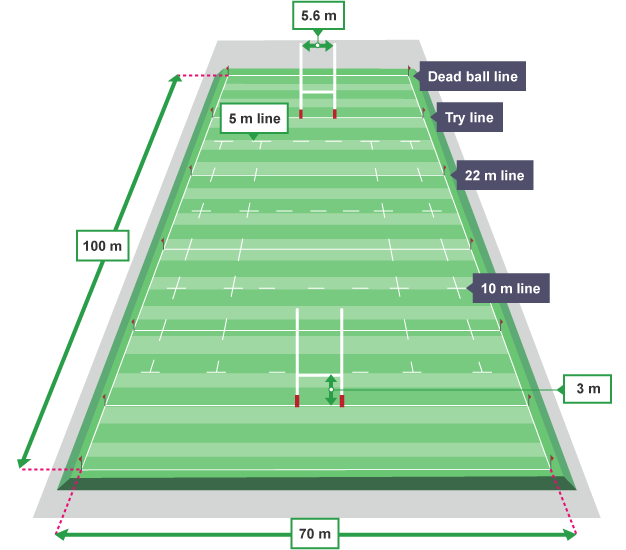
The pitch and how a game flows
A standard rugby union pitch is up to 100 metres long and 70 metres wide. At each end sits an in-goal area — the zone where tries are scored — bounded by the try line and the dead ball line. Key markings include the 22-metre lines (important for drop-outs and defensive resets) and the 10-metre lines (used for kick-offs).
A match starts with a kick-off from the halfway line. From there, possession changes hands through tackles, turnovers, penalties and kicks. Teams build phases of play — sequences of rucks and carries — to advance up the pitch. A kick to touch (the side of the field) stops play and restarts with a lineout.
Positions explained
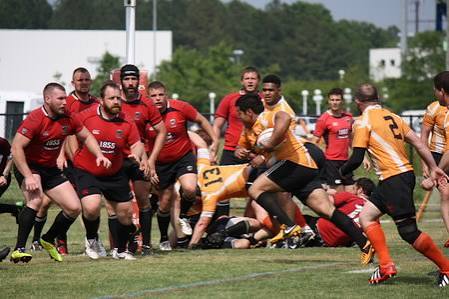
Each team has 15 players divided into forwards (1–8) and backs (9–15).
Forwards are the power unit — they contest scrums and lineouts, carry in tight spaces and dominate the breakdown. Props (1 and 3), hooker (2), locks (4 and 5) and back row (6, 7 and 8) make up the eight forwards. Front-row players are specialists in scrummaging; locks provide lineout jumping; flankers and the number 8 carry, tackle and compete at the breakdown.
Backs typically handle the ball in open play, exploiting space created by the forwards. The scrum-half (9) links forwards to backs; the fly-half (10) controls attacking shape; centres (12 and 13) run hard lines and make tackles; the back three — two wingers (11 and 14) and a full-back (15) — provide pace, aerial ability and counter-attack threat.
How to score points
| Method | Points | How |
|---|---|---|
| Try | 5 | Ground the ball in the opposition's in-goal area |
| Conversion | 2 | Kick through the posts after a try |
| Penalty kick | 3 | Kick from the spot of an infringement |
| Drop goal | 3 | Drop-kick through the posts during open play |
Tries are the primary objective. A successful conversion turns a try worth 5 into 7. Penalty goals are crucial in tight matches — many professional games are decided entirely by penalty kicks when defences are strong.
Set pieces: scrums and lineouts
Two set pieces restart play after certain infringements or when the ball goes out of play.
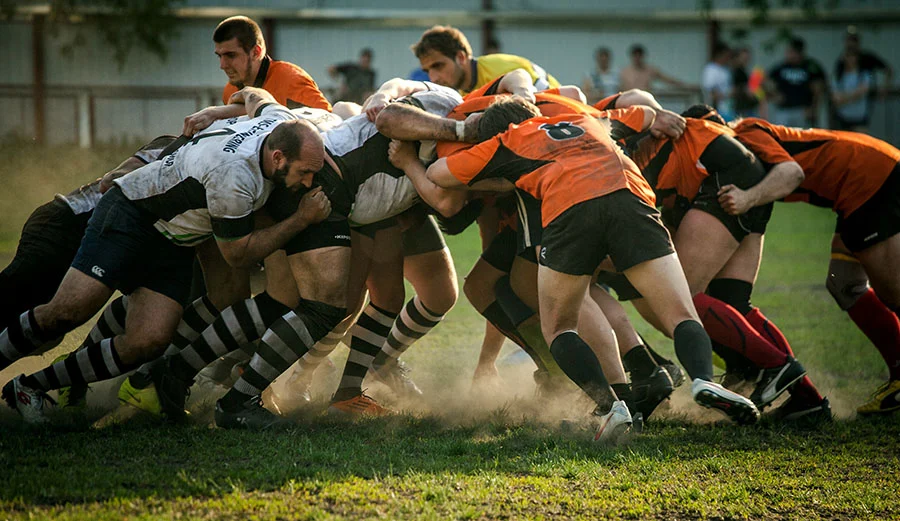
A scrum is awarded for minor infringements such as a knock-on. The eight forwards from each team bind together and push against each other; the scrum-half feeds the ball into the tunnel and the hooker attempts to strike it back through the scrum. The team that wins the scrum gets to attack from the base.
A lineout restarts play after the ball has gone into touch. Forwards from both teams line up perpendicular to the touchline and the hooker throws the ball in. Jumpers — usually locks — are lifted by teammates to contest possession at height.
Getting started as a rugby union player
The best way to start is to join a local club. Most clubs run beginner sessions and age-grade pathways from youth level upward. Contact rugby is introduced gradually — tag and touch rugby are the standard starting points for children. Adults joining for the first time are typically welcomed into development or social sides while they build confidence and technique.
If you are looking to be seen by scouts or coaches, a 5 Metre Scrum player profile gives you a verified digital CV — including your combine statistics, playing history and video highlights — that scouts can find on the scout board.
Frequently asked questions
How long is a rugby union match?
80 minutes of playing time split into two 40-minute halves, plus a 10-minute half-time interval. Injury time is added at the referee's discretion.
How is rugby union different from rugby league?
The main differences are team size (15 vs 13), the tackle law (union allows rucks and mauls; league uses a set-tackle system), and scoring values. Union places much greater emphasis on the contest at the breakdown and at set pieces.
Can anyone play rugby union?
Yes. Rugby union is played by men, women, boys and girls at every level from recreational to professional. The structured positions mean there is a role suited to every body type — props and locks benefit from size, backs benefit from speed and handling, but the game genuinely accommodates all shapes.
What fitness do I need to start?
No special fitness is required to begin. Club beginner sessions build fitness progressively. If you are looking to compete at a higher level, aerobic fitness (tested by the Bronco), speed and strength become increasingly important — our coaching guide covers training principles in more detail.